
Understanding the Usability of The ISS Online Advising Service
How well does the UW ISS navigation work in terms of guiding international students from homepage to the virtual advising Zoom link?
Usability Testing & Interview
Open Coding, Axial Coding, and Affinity Mapping
October 1 2023 – December 12 2023
Individual Project for HCDE 417
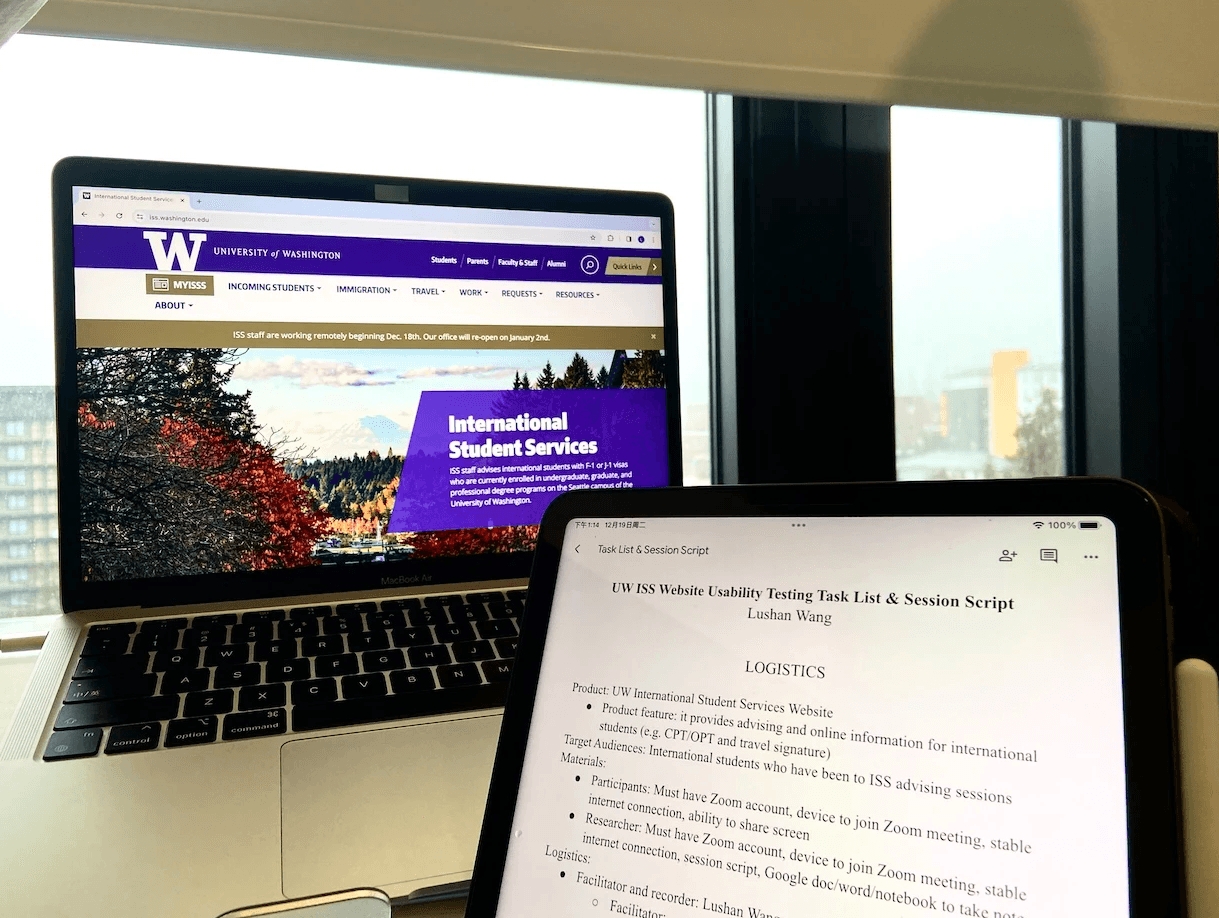
ISS Online Advising Service
The UW International Student Services (ISS) website provides essential information for international students to legally live and study in the U.S., including immigration policies, employment rules, and tax-filing information (International Student Services, https://iss.washington.edu/).
The scope of this study is limited to the ISS online advising service, where ISS staffs hold live sessions to talk one-on-one with the students to answer immigration-related questions, address concerns, and provide assistance. Currently, the ISS provides two types of advising services, online and in- person, where both types run on a drop-in first-come first-serve basis (Meet with an adviser, 2023). The scope of this study only includes the drop-in online advising service and is limited to the ISS website. It's important to note that the ISS currently does not enable students to schedule advising appointments, meaning that both the online and in-person advising are drop-in only.
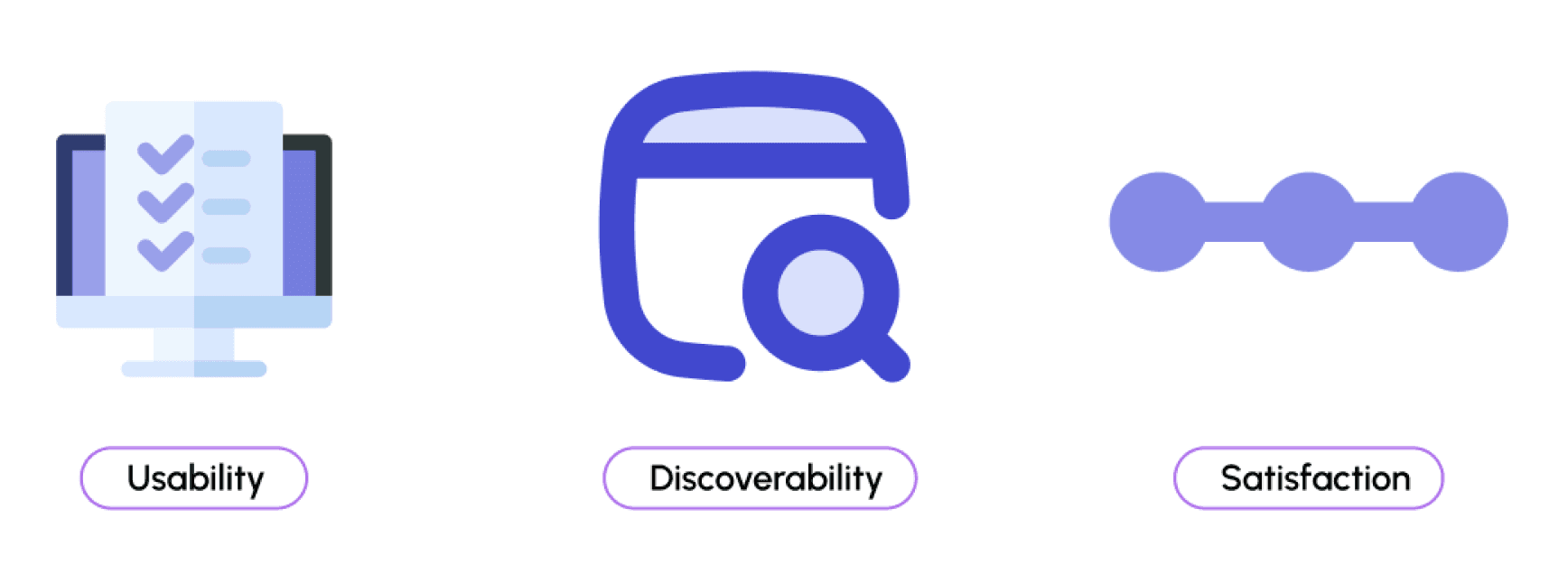
Attributes of Usability
This study focuses on understanding three attributes of the usability, usefulness, discoverability,
and satisfaction, for the navigation of finding the ISS online advising service.
By studying the usefulness of the website, I was able to interpret if the layout of the website matches students’ mental model and smoothly guide them to the correct page.
I chose to include the discoverability as one of the attributes is because I would describe the advising Zoom link as hidden and not obvious, and I was curious about other student’s perception about the discoverability of the link.
It’s important to also investigate students’ attitude toward and collect feedback on the navigation process for future improvements.
Icons by Iconduck
Impact
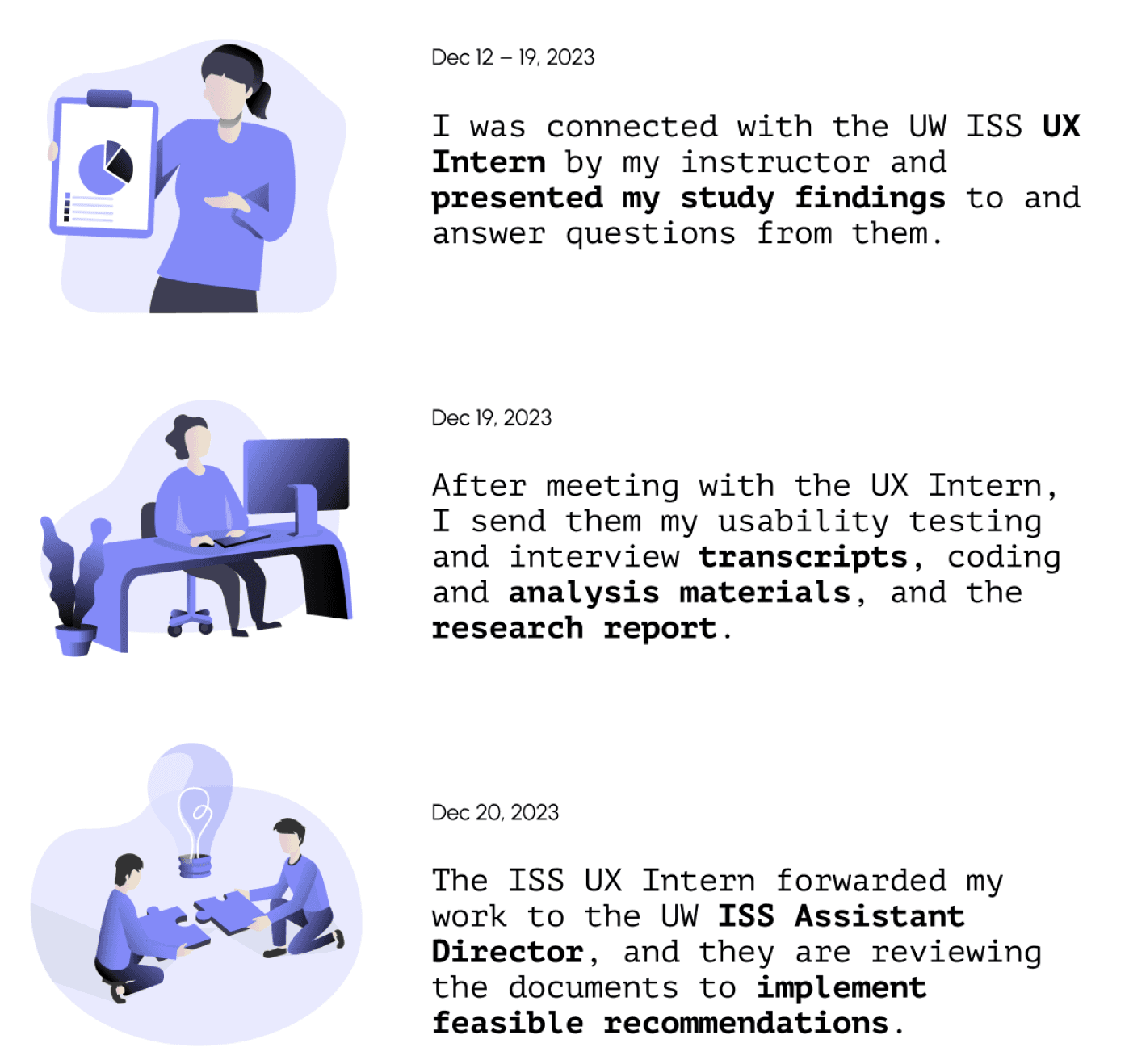
I was connected to the UW ISS UX designer by my HCDE 417 course instructor, and I was able to present my research findings and insights as well as provide my data and analysis to the designer, who will potentially implement my proposed changes on the website.
Positionality And Reflexive work
Positionality
I come from a background as an international student and a skilled user of the UW International Student Services. I have been interacting with the ISS since 2020 and attended at least 2 virtual and 2 in-person advising sessions, so I am familiar with the mechanics of the ISS advising from a user's perspective. However, since my most recent attendance of the advising service was 7 months before the time this paper was constructed, I recognize and acknowledge the biases that I brought from my previous interactions with the ISS, which might not reflect the most up-to-date policies and technology of the current ISS system.
Reflexive Work
To reduce the amount of bias that I brought from my positionality, I have read through the ISS website and tried my best to align my report with and present information about the most recent website navigation and advising policies instead of making presumptions about the processes based just on my personal experiences.
Methods
Research Questions
RQ 1: How well does the UW ISS navigation work in terms of guiding international students from homepage to the virtual advising Zoom link?
Sub-RQs for RQ1:
How many participants can find the virtual advising Zoom link without instructions from researchers or searching online?
What is a participants' way-finding process for attempting to complete the task?
How many participants attempted to read the post linked in the additional details?
What are participants' reactions and/or emotion expressions during the process? And why?
RQ 2: How to improve the ISS system to better support the needs of the international students?
Recruitment and Screening Survey
I recruited four participants through direct messaging the Google form of my screening survey link to international students that I know of. Since I’m interested in understanding the ISS advising service from international students’ perspective, anyone who was interested in the survey would have to be a UW international student and had previous interactions with the ISS advising service in order to proceed in the screening survey.
The screening survey consists of three sections, where the first section asks about participant’s name and if they are a UW international student; and if they are not an international student, they would be directed to the end to submit the survey. The second section asks for some general information and input from participants, including the following questions:
• Is English your first language?
• What is your visa type?
• Have you ever attended any advising session provided by UW ISS?
• Please rate your satisfaction regarding the usefulness of the information provided by the
advising sessions that you’ve attended (1 = not satisfied at all, 5 = very satisfied)
• Please rate your satisfaction with the navigation of the ISS website (1 = very hard to navigate, 5
= easy to find information)
The third section asks participants to provide email, choose the form (online or in-person) in which they wish to participate in the testing session, and input their availability for me to schedule the sessions (See appendix for more information).
All of the four participants are F-1 international students who have attended ISS advising sessions.

Icons by Iconduck
Usability Testing Sessions
The usability testing sessions are conducted in-person, where I had my laptop set up with Zoom for recording and invited participants to study rooms and attend the sessions.
The testing sessions had four parts, where in the first part, I introduced the purpose of this study and asked for participant’s consent to record audio and laptop screen. After having their consent, I would start to record audio and the screen on Zoom for the following three parts of the session.
The second part was a brief pre-task interview where I asked participants about their purpose of using the ISS website and advising service, as well as their familiarity with attending the advising sessions.
Transitioning into the third part, I asked participants to use the actual UW ISS website to navigate from the homepage to the Zoom link to virtual advising session for testing the usability of the navigation process.
Finally, during the fourth part, or the semi-structured post-task interviews, participants were prompted to share about their experience and feedback for attempting to perform the task.
Findings

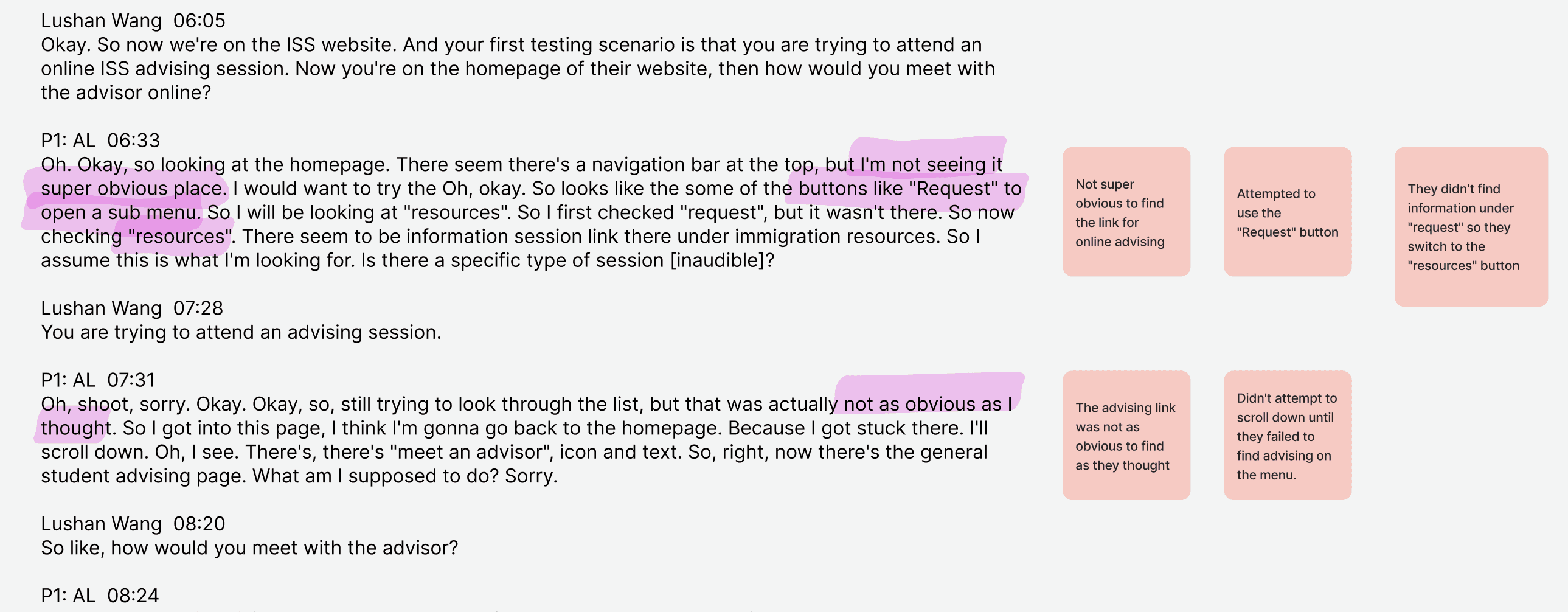
Left: Data and qualitative coding. Right: Excerpt of coding.
Task Completion
One of my sub-RQs asks about the number of participants that can complete the task without instructions from researchers or searching online. It turned out that 3 out of the 4 participants successfully completed the task, and 1 of them believed themselves completed the task while they did not. To understand why would this participant failed the task, I went back to the usability testing session recording and found the potential reason that led to the failure of the task.
Confusing Wording: “Virtual Advising” Versus “Virtual Front Desk”
The participant who failed the task correctly landed on the “Meet an Advisor” page, but instead of checking the schedule for the virtual advising sessions, they were drawn to the “Virtual Front Desk” under the “Contact ISS” section. I noticed this situation during the testing session, so I reiterate their task of meeting an online advisor to this participant and asked the participant if they think the place they’ve landed on was the correct place to see an online advisor. The participant insisted they’ve completed the task, so I asked them during the post-task interview how would they interpret “virtual front desk”. This is what they responded to my question:
“I will say virtual front desk, just the people through Zoom to answer the questions. It's just
the similar way as the in person but it's just that we move to the online one.”
The participant explained that they perceive the virtual front desk as the online version for the in- person advising service. Then since I was curious about the participant’s reactions when they found out that virtual front desk does not provide advising service, I pointed out that virtual front desk is actually a separate concept than the virtual advising, and this is what the participant responded:
“Yeah, it is confusing because in my mind, I think advisors should be just [inaudible] the
front desk. So I, I default saw the virtual front desk as the advisor.”
The participant explained that they thought they’ve completed the task because their mental model for this participant is that the advisors should be at the front desk. Also, the participant used the described the wording of virtual front desk as “confusing”. I hypothesized that since “virtual advising” and “virtual front desk” both have the word “virtual” in it, it could cause confusion for international students when interpreting the function of these two services.
None of the Participants Read the Post in Additional Details
To address my third sub-RQs, which is “How many participants attempted to read the post linked in the additional details?”, I went back to the recorded video to watch participants’ way-finding process during the testing session. Interestingly, none of the participants read or attempted to read the post linked in the “Additional details” on the “Meet an Advisor” page. The post is a well-written document describing detailed process of attending a virtual drop-in session (Visiting virtual drop-ins? learn about how they work!, https://iss.washington.edu/visiting-virtual-drop-ins-learn- about-how-theywork/). This post contains essential information such as the maximum capacity of the virtual drop-ins, but none of the participants attempted to read the post. Thus, I would argue that the place of where ISS put this information is not obvious enough for students to even attempt reading it.
Discussion
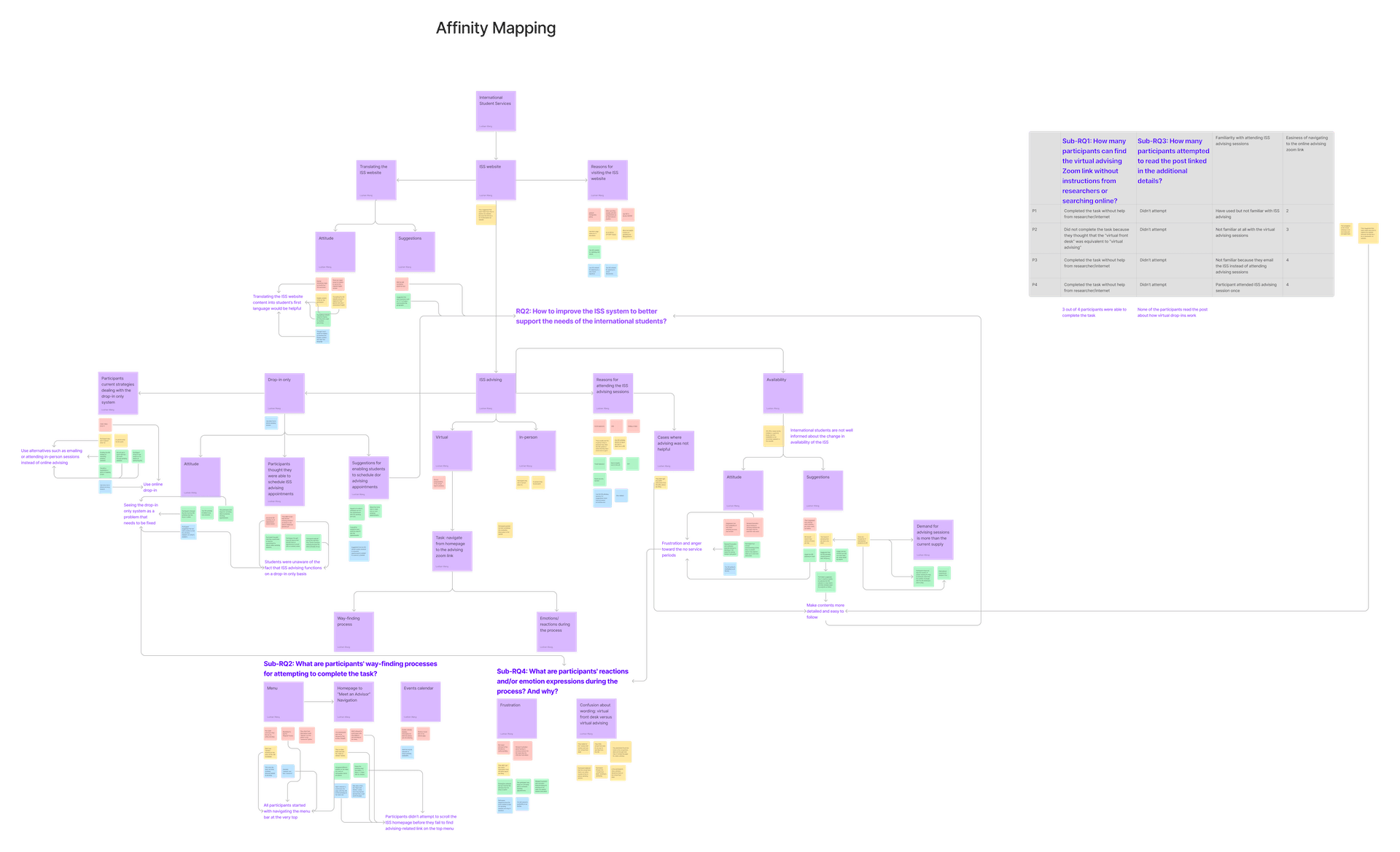
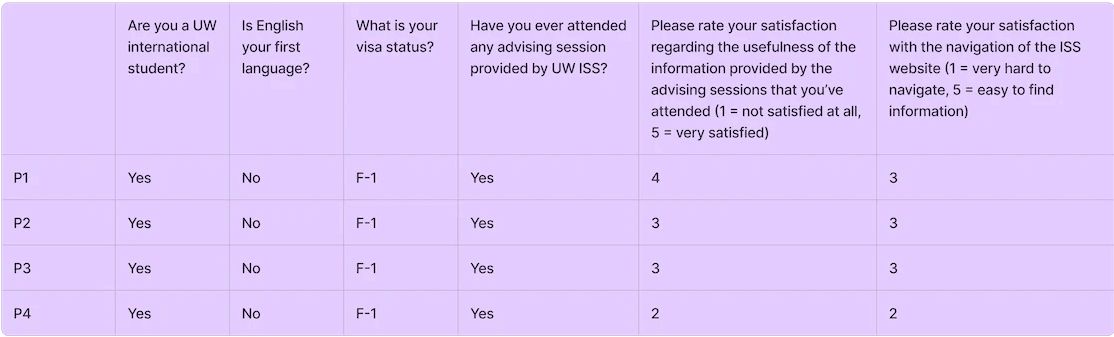
Left: Affinity Mapping. Right: Survey data.
Poor Discoverability for the Scrollable Homepage
Participants didn’t attempt to scroll the homepage until they failed to find the virtual advising keywords on the menu bar. For example, After P1 clicking on the immigration information session page and realizing that this page was not what they should be looking for, they said,
“I got into this page, I think I'm gonna go back to the homepage. Because I got stuck there.
I'll scroll down. Oh, I see. There's, there's ‘meet an advisor’, icon and text.”
This quote shows that P1 didn’t try to scroll down the homepage until they “got stuck” on the menu bar. Similarly, P2 also went through a similar process of attempting to find any button on the menu with the “advisor” keyword. They scrolled down the page because they “didn't see any advisor this keyword on the menu part”. P3 was able to find the “Meet an Advisor” button under the “About” part of the menu, and it demonstrated once again that P3’s intuition was to navigate the menu bar instead of scrolling the page. P4 also had a similar navigation process, where they said,
“Okay, so I'm not seeing anything that's directly related to advising. I would probably think
maybe request or resource. I don't think I'm seeing advising in any of these choices, I'll go to
the resource part. And I'm not seeing where they're saying like individual –– Okay, now here
I scroll down and I see this meet an advisor.”
Once again, P4 didn’t attempt to scroll down the page until they felt like unable to find the advising link on the top menu bar. The shared experience of the four participants indicates that the discoverability of the fact that the ISS homepage is scrollable is poor. I hypothesized that the reason for such poor discoverability is that the picture on the top of the homepage is large and it takes almost the entire screen to display the picture. That might cause users to feel like there isn’t any content below the picture, while in fact there are a lot of information underneath the picture.
Frustration Towards Multiple Aspects of the Advising Service
First, one participant, P1, expressed frustration towards the discoverability of the virtual advising link. During the usability testing session, below are P1’s reactions when navigating the ISS website:
“Okay, so looking at the homepage. There seem there's a navigation bar at the top, but I'm
not seeing it super obvious place.”
“...still trying to look through the list, but that was actually not as obvious as I thought.”
Second, participants showed frustration towards the availability of the ISS advising service
because the advising time slots are less flexible and being pre-determined by the ISS. For example, when I ask the about participant’s attitude towards the availability of the advising sessions, P4 responded,
“... I saw the calendar there, they're not that available in terms of like flexibility on time or
like specific days during the week.”
Third, two participants, P1 and P3, showed frustration when they found out that the advising service was not available during the week that the usability testing session took place. The context was that during the week that the testing sessions was conducted, there was a notification on the top of the ISS website saying that advising sessions were not available during that week. After discovering and reading this notification, P3 said,
“And there is no advising this week. Okay, they, why do they do that? They can just not
come to work at they like and then just throw one like okay, we're now closed or not open
today. That's not okay. Okay. They can. When they need to work they need to work.”
In this quote, P3 used phrases like “that’s not okay” and “When they need to work they need to work” to express frustration and anger towards the fact that the ISS was not providing service during the week that the testing session took place.
The Drop-In Only Advising System
Participants’ Mental Model
While one participant was aware of the drop-in only advising system before the usability testing session started, the other three thought they were able to schedule advising appointments with the ISS. P1 said that they think “you can also schedule a session on the website”, and P2 said they would rather go to in-person advising sessions and “I didn't do any appointments online
because I think their system is kind of awful.”, and P3 also said they would have to “at least book the appointment on website” for attending advising sessions. My interpretation is that, in these participants’ mental model, it’s intuitive and natural to think the advising services as appointment based. Therefore, I would argue there is a mismatch between the top-down structure (drop-in only) and the bottom-up perception (appointment-based) of the ISS advising service.
A Problem to Fix
One interview question that I asked was about participants’ attitude towards the availability of the ISS advising service, and P3 shared their opinions with the drop-in only system:
“I think it's stupid, like not gonna lie, I feel they can do much better job if they take some
experiences and lessons from what's it called? Career Center? They instead of having
everyone to wait for drop in, they kind of ask you to do they always they always have drop
in like sessions, but they also have something like, you can just book your 10 minutes, you
know, meeting through zoom. So you make sure that time is yours.”
Based on the quote, P3 criticized the fact that the ISS advising only has drop-in option and suggested that the ISS should allow students to book online advising meetings in addition to the drop-in sessions. P4’s answer resonated with what P3 said when I asked them “Would it be helpful if the ISS extend their current advising service hours, for example, longer services in a day or more days of services in a week?”,
“I feel like the main problem is they're having this more like a drop-in session, but if they
function based on appointment, they can kind of see like what schedule would fit the
student better.”
Instead of directly answer to my question of the helpfulness of extending advising service hours, P4 phrased the drop-in service as the “main problem” and suggested that an appointment-based system would benefit the international students.
Current Strategies Dealing with the Drop-In Only System
During the post-task interviews, I asked the participants how they were interacting with ISS advising service without the scheduling function. While two participants decided to stick with the virtual drop-in advising and one participant chose to attend the in-person sessions, the other participant, P3, found emailing the ISS office as the alternative way of contacting and retrieving information from the ISS,
“Like, if you email them, they can get you on the next day, or at least within two days, so I
found just emailing them is very helpful.”
“They should let more people know that they actually have good emailing service.”
In these two quotes, P3 commented positively on the ISS emailing service by describing it as “very helpful” and “good”. It’s interesting that this participant chose emailing over the one-on- one advising service because I would perceive advising as a more efficient means of getting information.
And some questions arise from this finding were: Why did this participant chose to email the ISS over advising? What are other potential means to contact the ISS besides attending advising sessions and emailing them? Are any of those strategies a more convenient or efficient way of communicating with the ISS?
Demand for Advising Exceeds Supply
Another finding about the ISS advising was that the demand is much more than the supply. In the post-task interview, P3 pointed out,
“Yeah, I mean, every single time I go there, it's always so crowded, you know, it's so busy.
Obviously, that more people are seeking help than the ability that they're able to provide.
International students always in line, you know, they either hire more people or up, you
know, improve on their efficiency.”
According to P3, the advising sessions are “always crowded” and “busy” and that international students are “always in line”. The UW currently have thousands of international students and the virtual advising sessions only admits 12 or 24 students per day. And I think one of the reasons that caused the crowdedness was that the demand for advising exceeds the supply. If I were to continue study this topic, I would be interested to know what an ideal student-to-advisor ratio for the UW ISS advising would be.
Limitations
Personal Connection
First, I acknowledge that the data analysis process could be biased due to the fact that the data was interpreted from my perspective as an international student and a very skilled ISS website user. Moreover, due to personal connection to the ISS advising service topic, I had my own insights and thoughts about the ISS and those might bias the data collection and analysis processes.
One-Person Research Team
Second, the number of participants was limited in this study, specifically, I only conducted 4 usability testing sessions because of the small size of the research team and limited time. I acknowledge that having a small sample size like 4 does not generate statistically significant data, and I would like to recruit more participants if I had more time or a larger research team.
Limited Time and Resources
Third, this study was conducted within 10 weeks and limited resources, and if I were to have more time and resources to expand the research scope, I would be interested in testing the whole ISS advising process in addition to the ISS website navigation. The process of attending a virtual ISS advising session is much more complicated than just finding the Zoom link, and it would be extremely valuable to investigate every step in the process for the ISS to make appropriate adjustments to the current system.
Design Recommendations
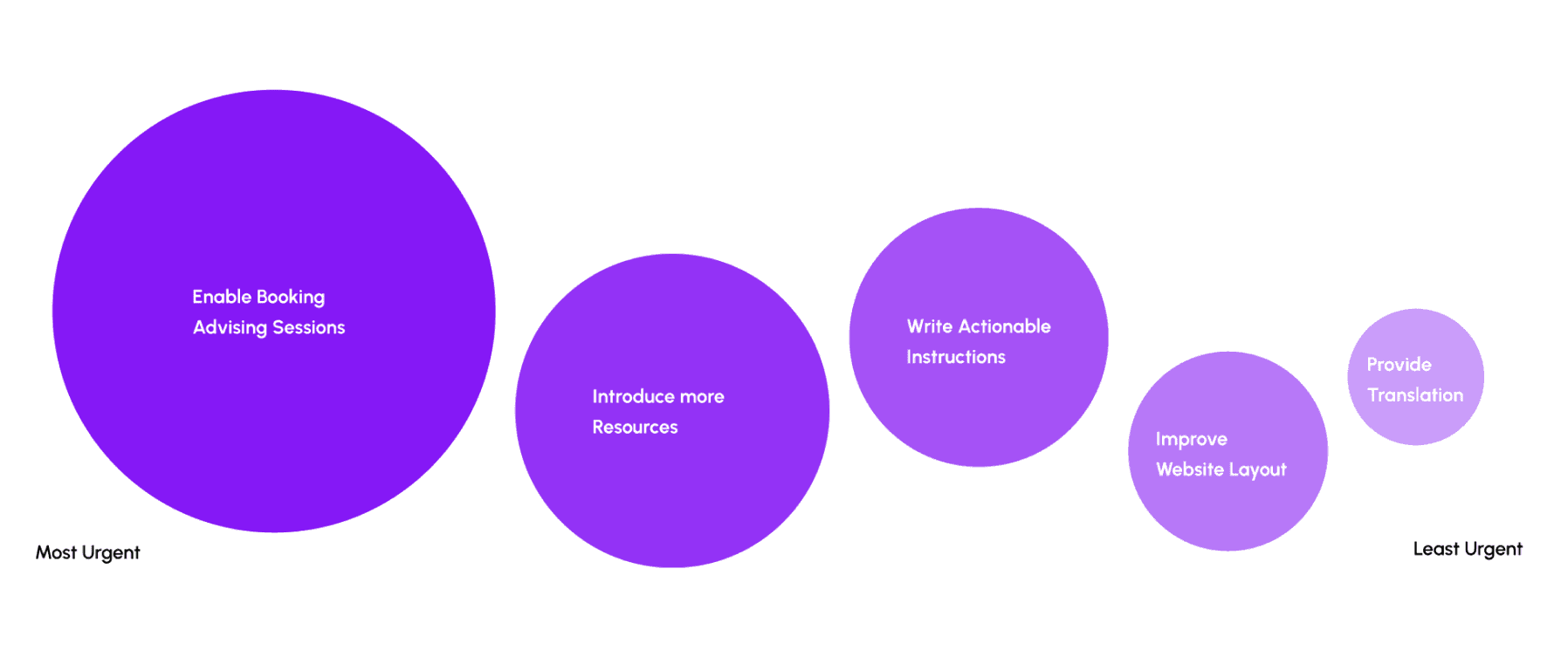
Enable Appointments
Recruit Advisors and/or Increase Availability
Write Actionable Instruction Posts
Improve Website Layout
Translate Website into Different Languages
Impact
Icons by Iconduck
Wrap Up
Conclusion
This usability study examines the usefulness, discoverability, and satisfaction of the UW International Student Services virtual advising system. By carrying out usability testing sessions with F-1 undergraduate international students, I was able to take a deep dive into the virtual advising problems generated by interconnected concepts including the advising system, the website layout, and other services provided by the ISS. The ISS is the place to provide information and assistance for international students to legally study in the U.S., and as more problems emerged throughout the study, such as drop-in only advising services, unreasonable student-to-advisor ratio, and less discoverable content, I would like to advocate for international students to be receiving more attention and resources from the ISS.
© 2026 Lushan Wang. All rights reserved.