
Improving the UW Disability Resources for Students (DRS) Testing Accommodation Process
How might we streamline the scheduling process to reduce stress for DRS staff and improve the student experience?
Observational Study
Interview
Qualitative Coding and Analysis
February 1 2023 – May 31 2024
HCDE BS Capstone, Sponsored by UW DRS
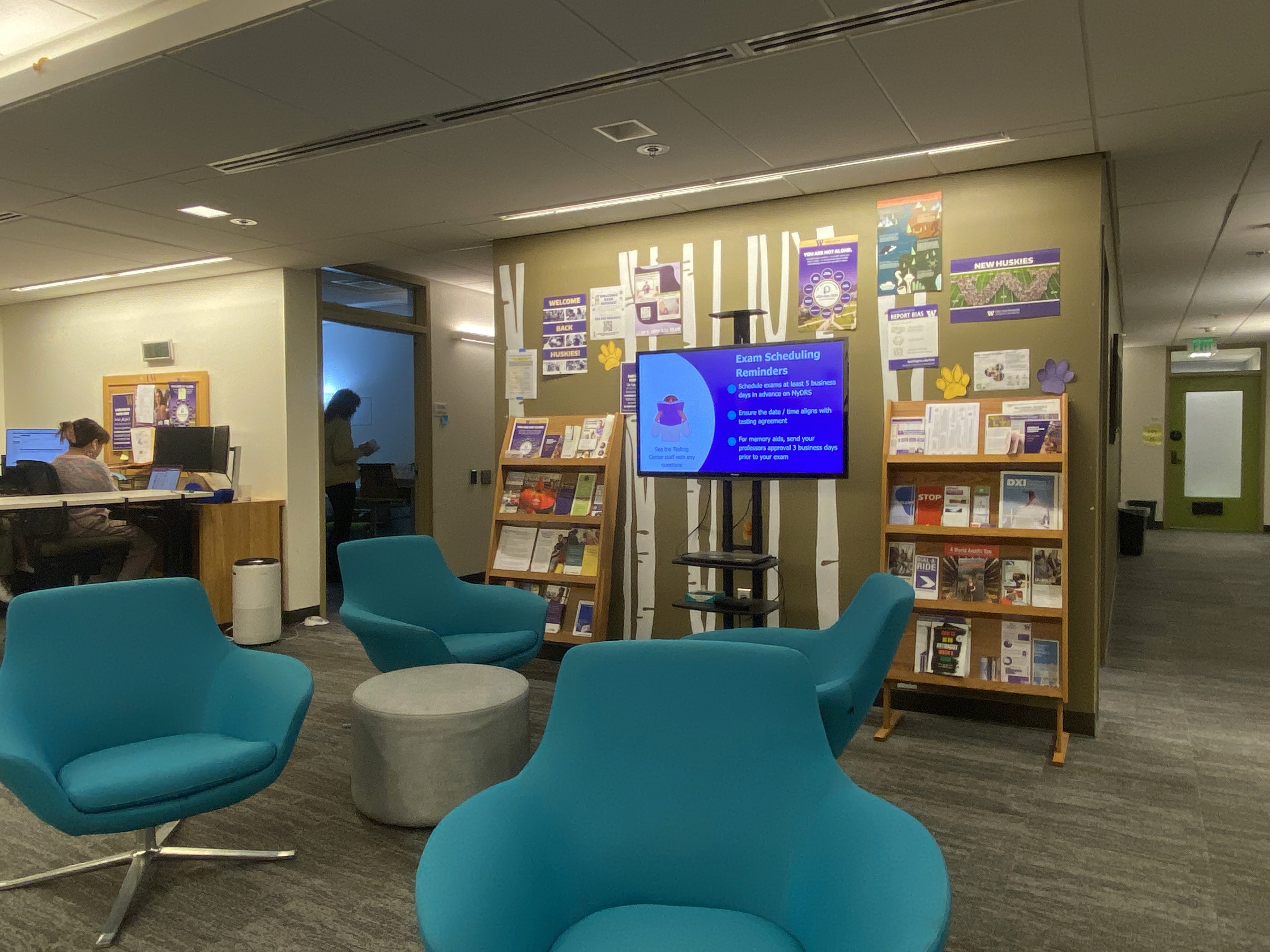
Project Overview
Intro
UW DRS (Disability Resources for Students) provides personalized academic accommodations to support needs of the disability community. Our capstone project explores the testing accommodation process at DRS, identifying opportunities to alleviate tensions between instructors and DRS.
Goal & Design Question
Our goal is to make the testing accommodation process easier for multiple stakeholders, guided by the following design question: How might we streamline the scheduling process to reduce stress for DRS staff and improve the student experience?
Executive Summary
Our capstone project aims to investigate the test accommodation process at UW DRS and suggest improvements to streamline the process for both instructors and DRS staff. The test center, a branch of DRS, provides staffing, space, and resources to help departments and instructors support students with disabilities during testing. Our methodology involves two phases: data collection and analysis. Data collection allowed us to identify the problem space, and analysis enabled us to develop key recommendations for future reference.
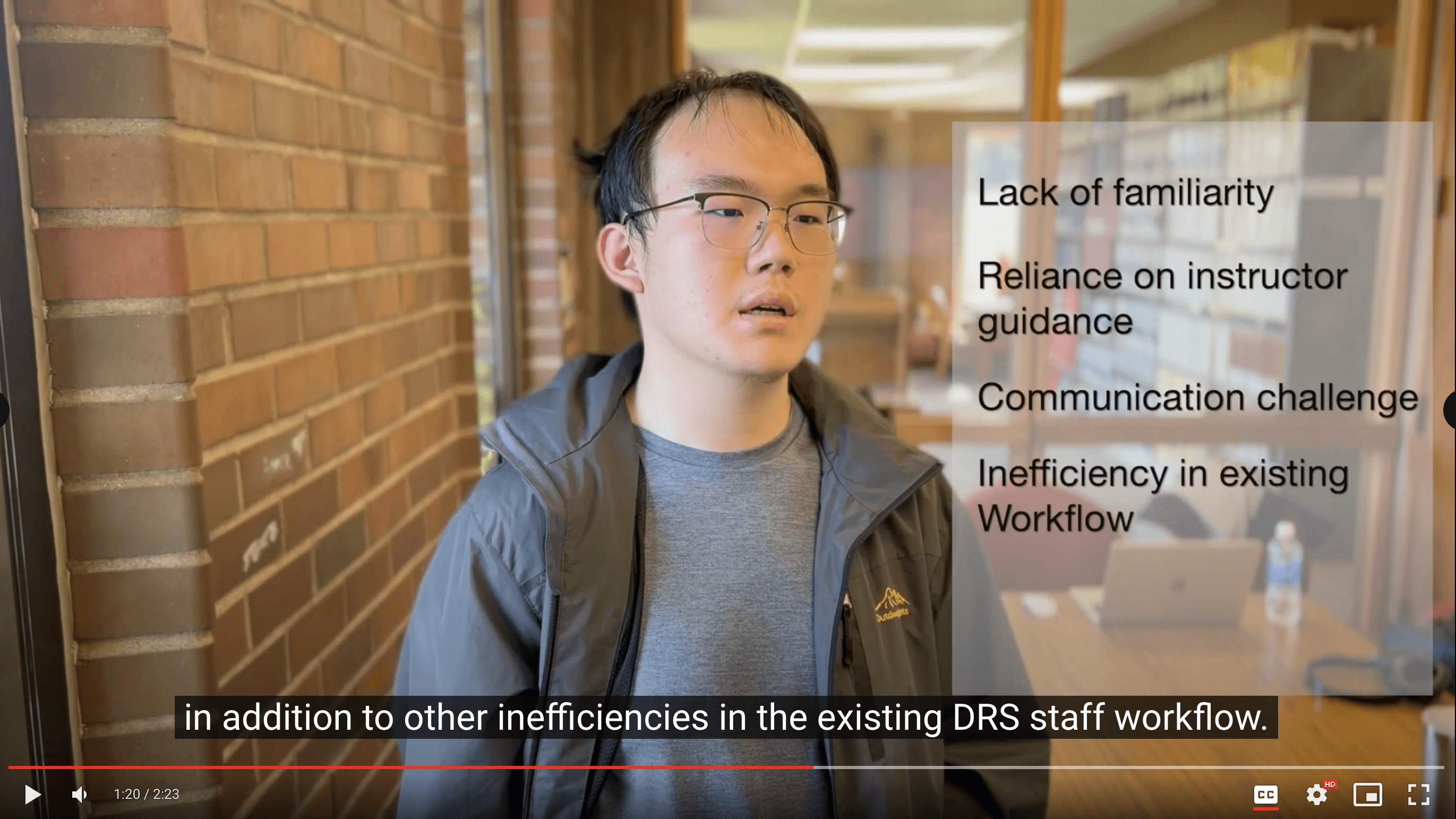
Some of the key findings include students' lack of familiarity with DRS services and the testing accommodation process; instructors' challenges in guiding students through the accommodation process; notable communication inefficiencies among students, DRS staff, and instructors; hardships in the existing DRS staff workflow; and issues with the usability and accessibility of the current DRS web portal.
Our recommendations include several implementations: a poster to enhance students' awareness of DRS; a visualization of the accommodation process; an automated tool to schedule time and seating for tests; a communication tool for answering questions during accommodated testing; and updates to insufficient functions on the DRS web portal, such as unlisted pages, tedious navigation, and outdated design. We have also categorized two recommendations for design work and summarization efforts. The design work will involve creating posters that provide clear and concise guidance for getting started with DRS.
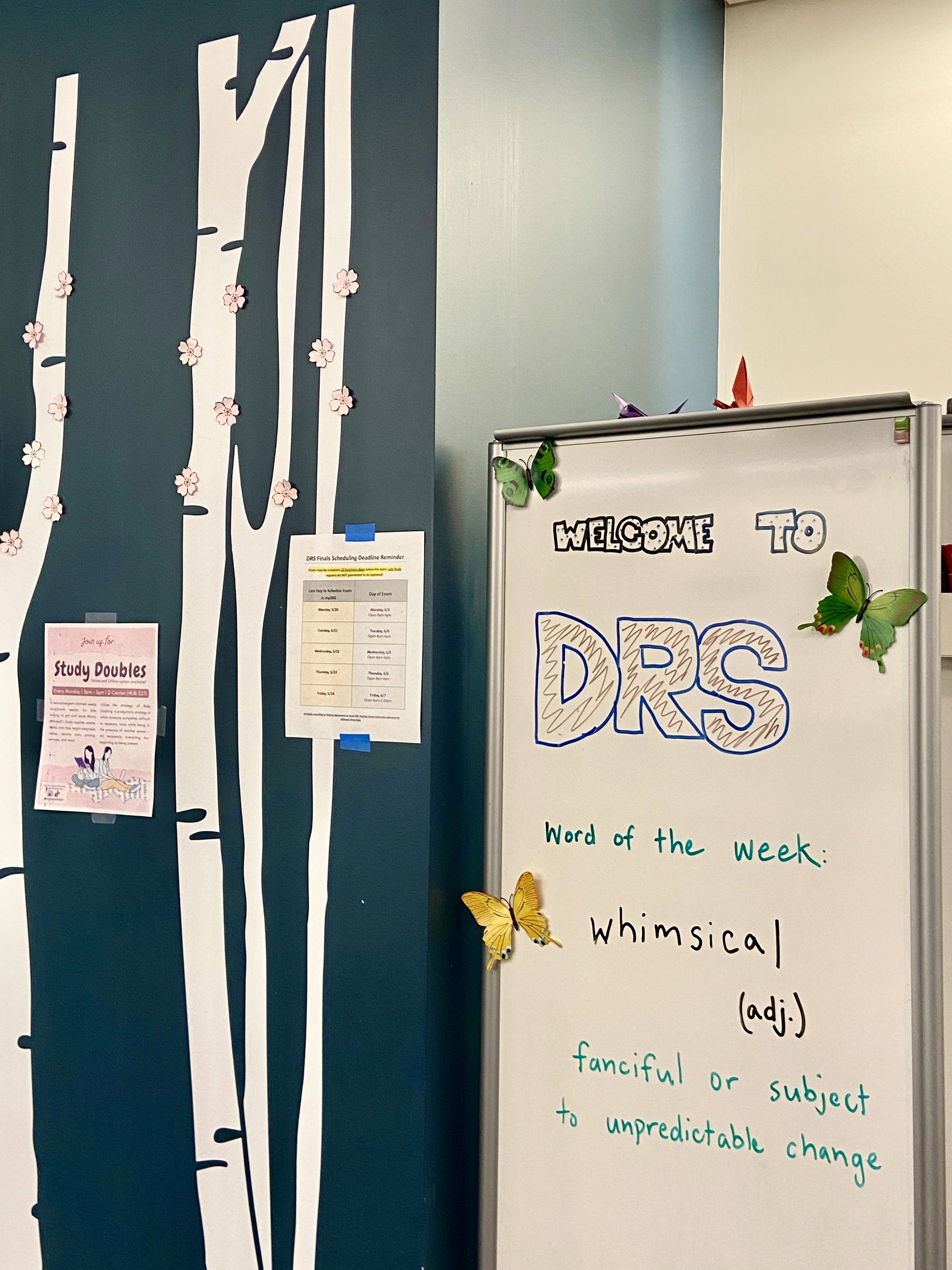
The UW Disability Resources for Students (DRS) Office
Deliverable #1: Recommendations
Creating an automated tool to schedule exam time and seat
Create automated tools to ease the burden of manual exam scheduling and seat assignment.
The tool can either automatically place students into an exam schedule or provide suggestions to DRS staff on how they can schedule students. The latter would allow DRS staff to override & amend the suggestions generated by the auto-scheduling tool.
If the cost of commercial solutions is prohibitively high, DRS could look inward and see if a custom tool can be built in-house at UW (Could be a good CSE software engineering capstone project)
The tool should enable instructors to instantly react
Make long term investment to tools and processes to build a more sustainable workflow for DRS
The current scheduling workflow is time-consuming, error-prone, and tedious. Revamping it might be challenging at first but will be beneficial in a few quarters down the road.
It is easy for a computer program to take factors like extra time, flexible exam start/end time, and breaks not counting towards exam time into account when scheduling.
Enhanced tools free up student staff to spend more time communicating with faculties and students.
Offering alternative means to contact instructors during exams
Add more options for students to ask questions to instructors during their exams
The current tool DRS offers (email, phone) consists of inherent latency.
The alternative tool should enable both students and instructors to smoothly communicate, while not infringing instructors’ privacies.
Microsoft Teams, for instance, show the live status. DRS staff will have to report the instructors for neglect of duty nonetheless of their reason on latency.
The tool should enable instructors to instantly react
Implement texting option (Upgrade landline phone)
Space shortage & logistics challenge
Coordinate with UW Special Events to give higher priority for booking requests made by DRS
Continue to collaborate with academic departments to get classroom resources
Improve instructors’ understanding of the DRS process and their responsibilities
Modernize the UI
Make DRA submission available on website like DRS, instead of outdated way of writing and signing one PDF document per student
Improve the navigation from making instructors hopping into random links
Switching between courses
Change the behaviors of clicking students’ names from opening an email compose window to opening a page about the student’s accommodation arrangements
Make a spreadsheet table format of the student accommodation information
Develop new methods for instructor-student communication during DRS exams
Instant messaging platforms like Microsoft Teams has to reduce latency and provide guaranteed message delivery but we had to be cautious of its transparency
Consider a tool that resolves an inherent latency
Potentially allow multiple members of the teaching team to respond to student questions (e.g., course mailing list, discussion group)
Upgrade existing phone infrastructure at DRS to allow texting as a way to contact instructors
Request academic departments provide DRS access to their department-wide FERPA-compliant instant message platform
Deliverable #2: Flowchart
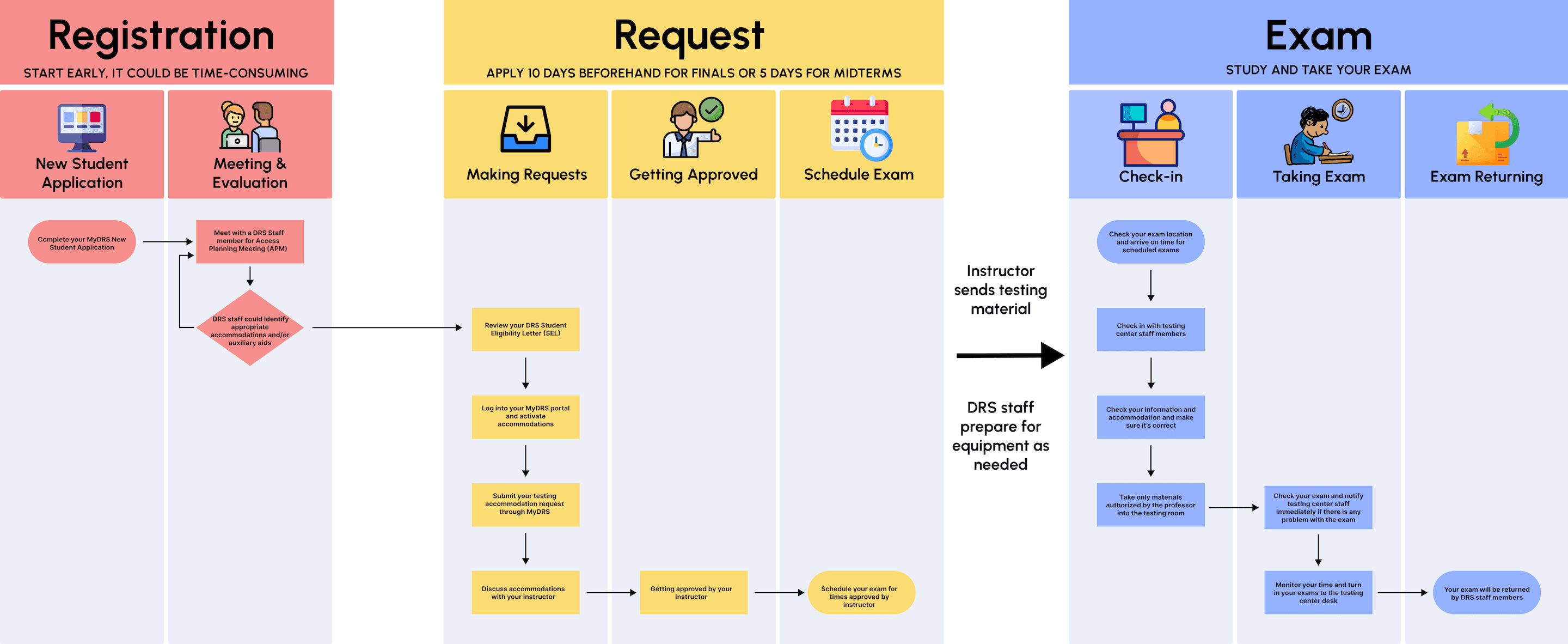
Step by step student guide
We created a flowchart that provide clear and concise guidance for getting started with DRS. This guidance will guide students with the concise and clear instruction, helping them understand and access DRS resources when needed.
Deliverable #3: Advertisement Poster
Advertisement Poster
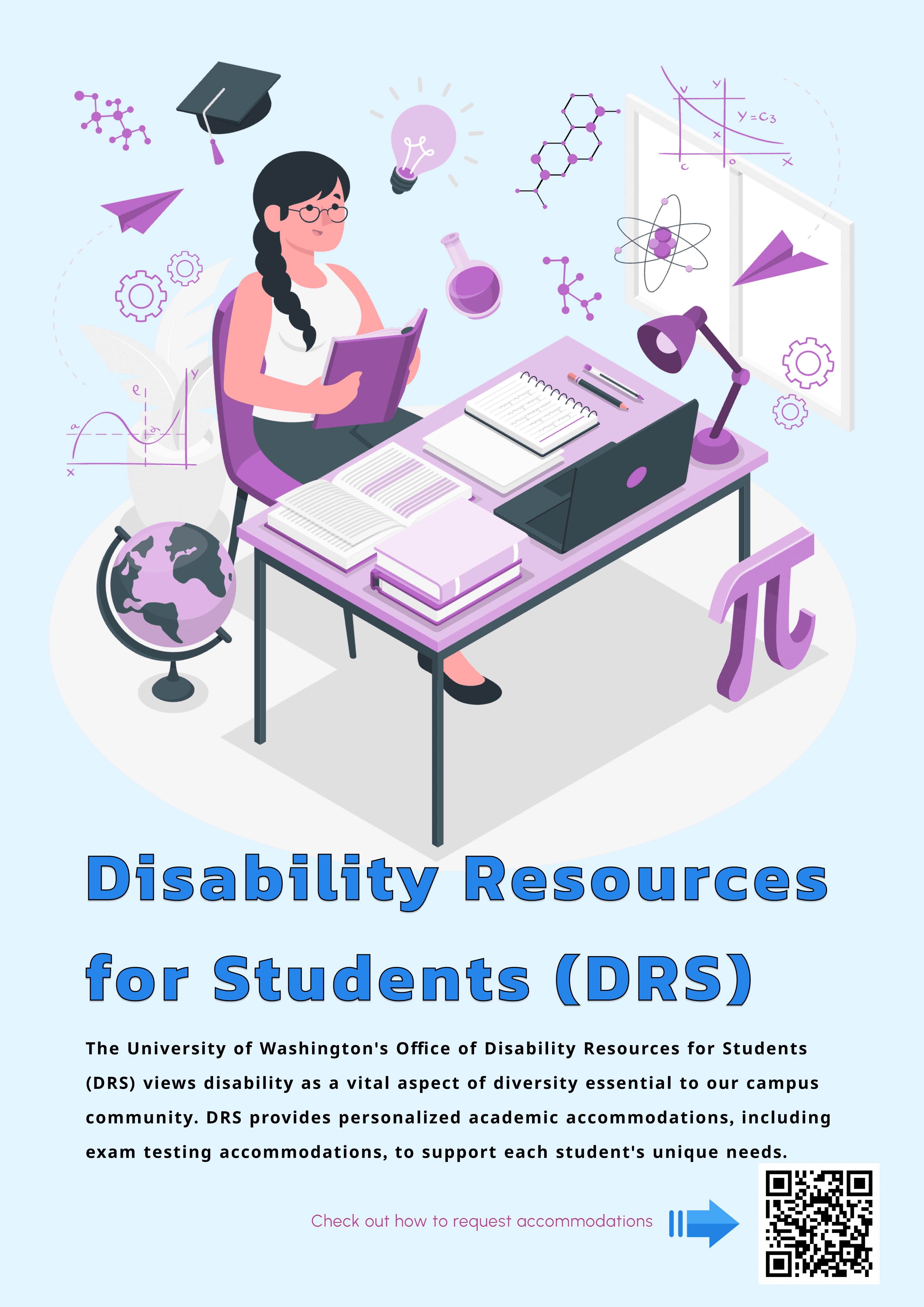
We designed the DRS advertisement facing to the UW students. This advertisement aims to increase awareness among UW students about the services and benefits of DRS.
Deliverable #4: SHowcase Poster
Advertisement Poster
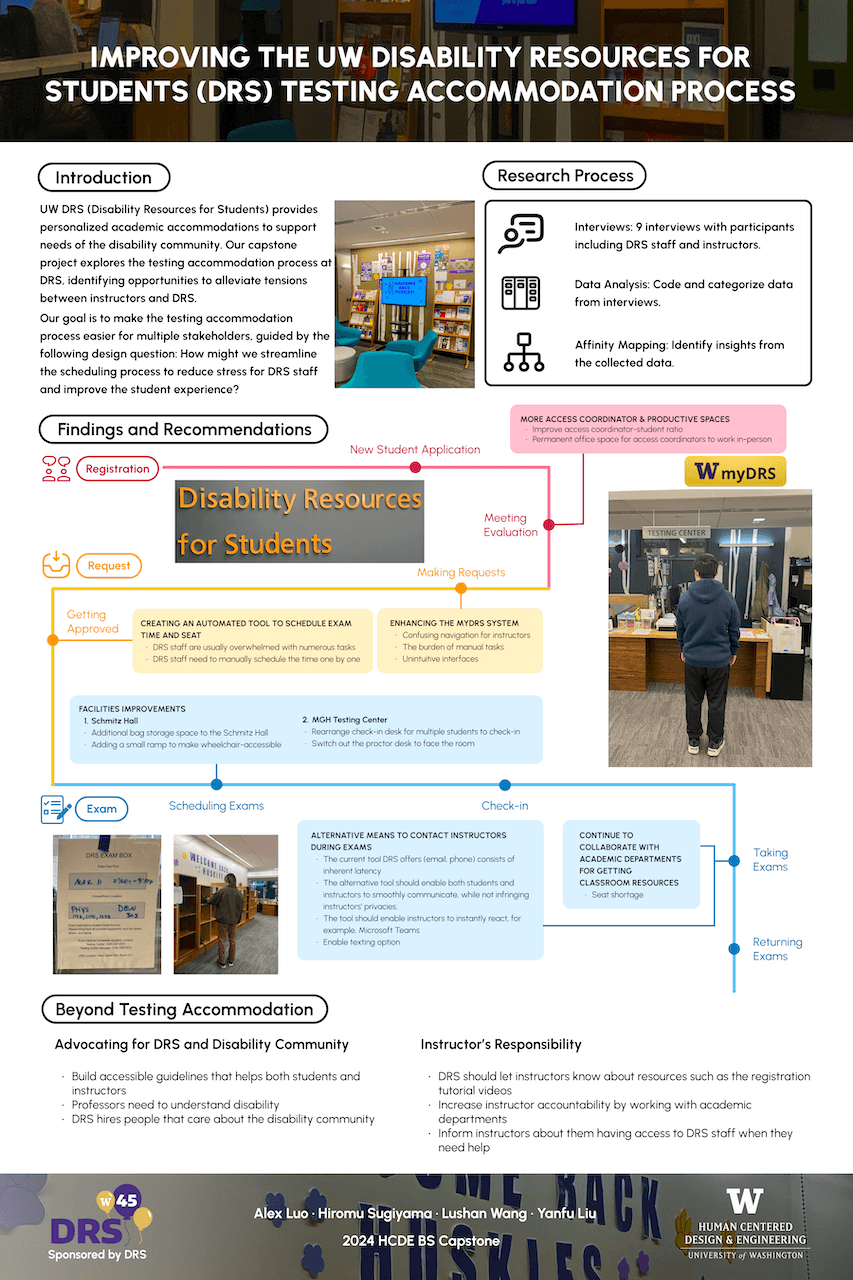
We created a poster that summarizes and communicates the essence of our finding and recommendation of DRS testing accommodation to members of the general public.
Deliverable #5: Showcase Video
Citation and Appendices
Cited Sources
Disability Resources for Students Homepage:
https://depts.washington.edu/uwdrs/
Getting Started with DRS:
https://depts.washington.edu/uwdrs/prospective-students/getting-started/
Team Bio
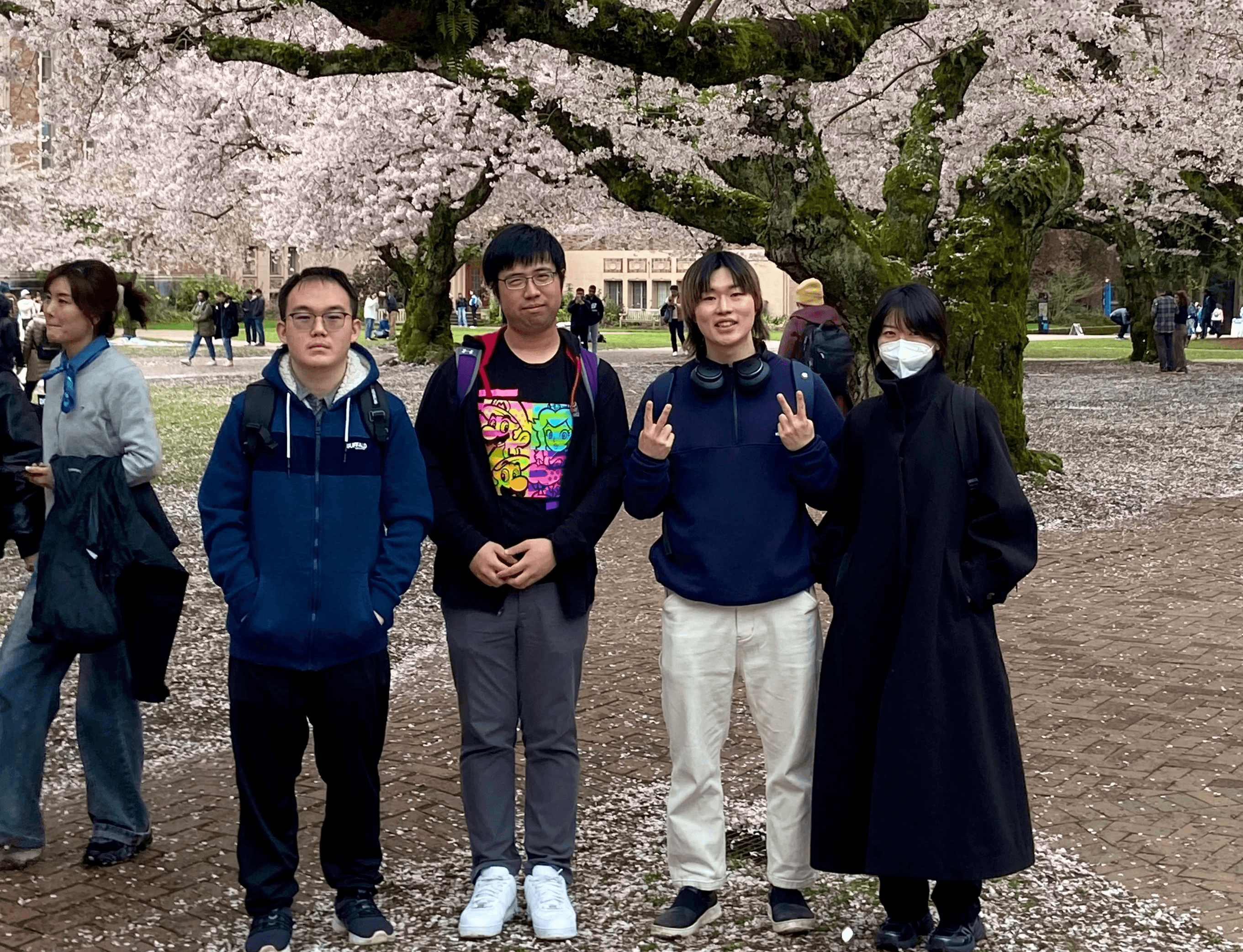
Left to right: Yanfu Liu, Alex Luo, Hiromu Sugiyama, and Lushan Wang
Yanfu Liu
I hope to get some valuable industrial experience in usability research and product development from this capstone. I possess a diverse background in the technology field, encompassing hardware development and machine learning. My expertise extends to UX design, UX research, and usability testing. Additionally, I am proficient in Python and have a solid working knowledge of MATLAB. I am deeply attracted to this capstone project, which aims to address pressing social issues. I am eager to bring my skills to our team to contribute meaningfully and enhance the impact we can make on society :)
Alex Luo
I like both researching and building “things” whether it’s a physical artifact or something running in the backend. My interest lies in the intersection of research and engineering (particularly when it comes to anything computing/accessibility oriented). I have experience in user research, usability study, software engineering, and computing education.
Hiromu Sugiyama
My goal for the capstone project transcends mere enjoyment; I aim to passionately contribute and create something meaningful. This aligns with my aspiration to bridge theory and practice, refine problem-solving skills, and gain deeper insights into HCD dynamics through hands-on experiences.
Lushan Wang
My academic interest is around human-computer interaction, human-subject research, physical prototyping, and education. I'm excited to be applying the skills and knowledge I've gained from my academic journey to analyze and solve real-world problems. I would love to contribute my leadership, user research, and design skills to my capstone team. I'm hoping to polish my project management skills and make some meaningful impact on the DRS system.
© 2026 Lushan Wang. All rights reserved.